Search This Blog

Sunday, 8 May 2016

The Coke Myth and the Renegade Who Generated it


Share a Coke With: A Quack
 Diet Coke

It appears that the infographic of ‘what happens 30 minutes after a can of coke is consumed’ appears to be circulating the internet again. However, although I heard a lot about it, I had missed the story the first time round last year and then completely forgotten about it. The graphic itself is produced by The Renegade Pharmacist, and spun into action by the Daily Mail and, of course, Natural News. The Renegade pharmacist, apparently, was a ‘licensed drug dealer’-turned good after witnessing how many drugs were prescribed each month. Isn’t it marvellous that we live in such a world that we can reject and go against conventional medicine based on this notion?

Renegade Pharmacist

Let that name sink in. They are an outlaw for pharmacy. Essentially, the website is against getting better through actual medicine. The about section of the website gives a profile of Niraj Naik, he appears to be semi-famous for the coke-gate (that’s what I am calling this), and that is about it. Before we talk about that, I’m going to point out the fallacies and riddles in his very own biography. First of all, “Certified Legal Drug Dealer” is a term they use for pharmacists, which is, technically correct. Its’ connotation however, that is not correct (using language to denote a deeper, sinister tone). They use the word ‘qualified’ and ‘certified’ about his pharmacy background, amping up the fact he has a pharmacological background, whilst at the same time calling them ‘drug dealers’ and demeaning the profession. Which is it?
 
“He also learnt of the debilitating side effects of the prescription medication which drove many of the patients to have to take more and more drugs to ease the side effects”

Errrrm...you really shouldn’t be giving people drugs for the side effects of drugs, unless they’re illicit drugs. So, lets not do that. As a pharmacist, how does he know the exact pathology as to why the patient requires the drugs? In other words, how on earth does he know that they are consuming more drugs to counteract the side effects of other drugs? So, after learning all this as a fully trained, qualified, certificated pharmacist, he decided (hopefully against his better judgment) to attend seminars on the ‘true origin of disease and prevention’ (I wouldn’t even know where to start in disseminating that title). Following this he swapped pharmacy for food, tools and websites to help people. The best line of all of this bio follows:

"After an arduous battle trying to get his novel approach accepted into the mainstream that resulted in a lot of stress and disillusionment, in 2010 he was diagnosed with a stress related illness, ulcerative colitis, that left him housebound for over 10 months."

This ‘arduous battle’ is no where near as rigorous and as regulated as the actual case of getting medicines from ideas to shelves. No where near. I wasn’t all to shocked to discover there is no evidence to say that ulcerative colitis is caused by stress. It is, however, caused by genetic and environmental factors. However, getting stressed can exacerbate the condition, but it is studied to be down to genetic factors and possibly environmental. Another case of Wikipedia being wrong and a story that ricochets with a little less than the truth from the offset.

Diet Cokegate

Yeah, the crux of this post. This guy is mostly famous for not knowing biology. No, errm... his highly scientific, dammit... his post of what happens when you consume diet coke. Let’s start from the beginning:

Diet Coke infographic 

10 minutes

Aspartame does not trick your body into thinking it has processed sugar. When digested, aspartame breaks down very quickly making phenylalanine and aspartic acid, hardly any enters the bloodstream. Which takes down the next part of the post saying aspartame triggers an insulin response. There is zero evidence of this, despite him saying something about there being studies on such things. I cannot find them, and believe me, I’ve tried. There are myriads of studies out there on sweeteners all with similar conclusions. For example published in the American Journal of Clinical Nutrition titled: Functional magnetic resonance imaging of human hypothalamic responses to sweet taste and calories 1’2’3:

"Glucose ingestion resulted in a prolonged and significant signal decrease in the upper hypothalamus (P < 0.05). Water, aspartame, and maltodextrin had no such effect."

As it doesn’t really enter the bloodstream, it would be quite impressive to illicit an insulin response.

20 minutes

In the original post by Niak, he cites some scientific studies. In this science game, it’s not just enough to cite them, you should probably read them too. The infograph above states that it is reported that there are higher risks of diabetes, high blood pressure and heart disease. The links he used to ‘back up’ these claims, actually don’t back them up. Each of the studies do not individually, or collectively, prove that the drinks cause any of these problems. At best, they show some association, there is a great difference between an association and a cause (pdf). Remember that whole ‘correlation doesn’t equal causation’? Yeah, apply that here, there and everywhere. There are a hell of a lot of factors involved in disease, singling it down to one cause and saying that there a 67% risk of increased diabetes is quite the stretch (even though only 8.2% of the subjects were identified to have got diabetes out of the 6814 subjects. I mean, that would only be a correlation if they consumed only diet coke and you would require more than two studies to back this up.

40 minutes
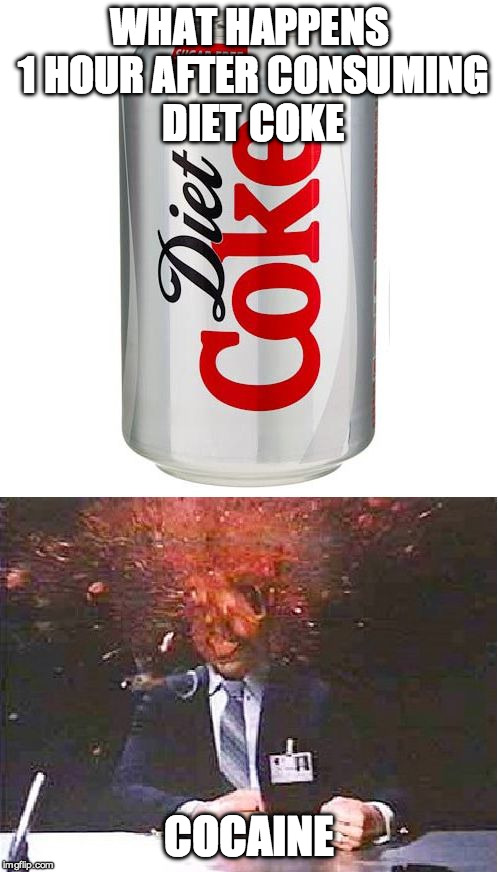
Addiction, that’s some powerful drink, eh? Potentially deadly combination of caffeine and aspartame, that’s new. So if I take sweetener in my ultra strong coffee, is that potentially deadly too? Why is only diet coke getting the bad rap here? Let put some scientific terminology in here ‘excitotoxin’ and ‘neuroreceptors’ and it sounds like hes’ done his research, or has he? A systematic review published in Critical Revolutionary Toxicology states:

"The studies provide no evidence to support an association between aspartame and cancer in any tissue. The weight of existing evidence is that aspartame is safe at current levels of consumption as a nonnutritive sweetener."

But his one source says it is deadly? No, it doesn’t even say that. And we are using some powerful and suggestive language here, yet again; cocaine. This guy is seemingly obsessed with drugs, why cocaine? If you drink coke, you may as well do cocaine, no other stimulate in the world could be compared to caffeine. Only cocaine.  

60 minutes

All your minerals are potentially depleted and you are craving more sugar and junk food. I drink diet coke and this never happens to me, maybe I am an anomaly or the science just isn’t there? I’m going to err on the latter, since the last points were highly incorrect. Yeah, there are more nutritious things out there, water for example, but I see no evidence of these causing cravings.


The Blog Post


So, it wasn’t enough for me that the basic fact of the reported biological processes was highly inaccurate. I wanted to know why he thought this acceptable? Well, he states on the post that:

"I found if people drink diet sodas they still get the same problems as people who drink normal soda."

As a pharmacist he is asking patients of the consumption of their drinks? That’s a little odd is it not? And then comes the pin in his ever-present lack of regard for science bubble;

"The research I found from other well respected scientists back up my claims up too and you will discover this in great detail in the new infographic and from this article."

Two words; confirmation bias. Got it, the entire thing is based on a fallacy, like all pseudoscience. "What I feel is shown to be true by these well respected scientists (I have no clue who is is talking about here) so it must be true". So he has gone out of his way to find studies that back up the claims he believes to be true. These studies are either highly preliminary or he has inferred a conclusion from them that just does not exist, in the same way that the media run with stories and in this case, did.

Conclusion 

Health experts say the information in this infographic is exaggerated.When you actually type the words ‘the research I found from other scientists back up my claims too’ you have kind of lost any credibility.  The conclusions drawn to make the ‘info’graph are not actually backed up by actual science. The entire renegade pharmacist website reeks of self-entitled, in touch with the earth, holistic anti-science.

I’ll leave you with this:

“He believes that the stress of modern living is the root cause of disease and poor health, and that treatment begins with self belief.”

So my diabetes and magnesium disorder is down to stress and not genetics? You may have become a renegade pharmacist, but you have become a regular quack.

Monday, 2 May 2016

Anecdotal Evidence is Not Evidence


  How 'it worked for me’ irks me
 
 shutterstock_185333696

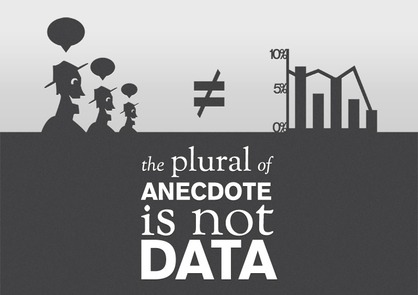
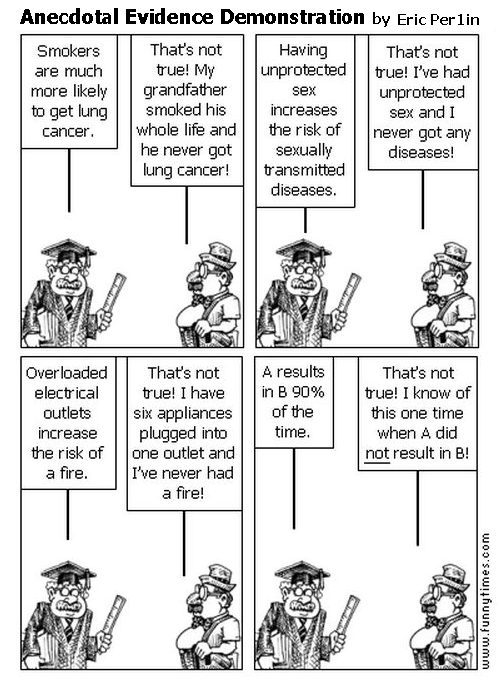
I hear that phrase constantly from doing what I do. I say cannabis doesn’t cure cancer; ‘it worked for me’. I say that GMO’s cannot cause an allergic reaction by replacing genomes; ‘Well, it did for me’. I say aloe vera doesn’t cure diabetes; ‘well it worked for me’. There is a phrase in the scientific skeptical community; ‘The plural of anecdote is anecdotes, not data’ – a sentence that resounds more truth that you will ever know.

How many anecdotes make for data?

How many pieces of string make a full ball of string? Well, how long are the pieces of string? What is defined as a ball of string? Think about that in context; what makes for evidence? You have a cold and you take an Echinacea tablet, your cold goes away and you put that down to the tablet, right? Is it not highly likely that your cold will go away on its own as your own anti-bodies fight off the virus, as opposed to a natural remedy? An anecdote is a story, nothing really more. As humans, we find anecdotes interesting and strive to see what works to cure the incurable. As scientists, however, we get a whiff of anecdotes and shut off. Or in my case, roll my eyes so hard I almost detach my retina. Anecdotal evidence, however much is complied, shouldn’t make for data.

The most captivating anecdotes are, of course, our own. We have a belief in something that was experienced personally, so it must be true, because we have seen it with our own eyes or felt it. It is a bias we all posses, but the skill to compartmentalise that bias is not. The reason we do not classify this as actual data is because there are so many variables. Take, for example, type 2 diabetes that is brought on by diet, which can be controlled by diet (which many people incorrectly call ‘reversing diabetes' or 'curing diabetes' – you are not, you are just controlling it. If you stopped doing what you are doing, the symptoms will return. Hence; not reversed or cured). If you are eating low carb diet and exercising after meals, your HbA1c level will decrease, meaning the complications of diabetes are unlikely to happen. Let say that you believe that this website is correct and the evidence for aloe vera was real in lowering blood sugar (it isn’t) – you then consume aloe vera alongside the diet and exercise. You could presume that the aloe is curing your diabetes, not the exercise and dieting. This makes for anecdotal evidence that shouldn’t really be entertained, but sadly is. This isn’t controlled by any means, there are so many variables its hard to begin to disseminate this particular scenario, and it is the same with most anecdotes.

Can it ever be data?

In a nutshell; no. I will hammer this point into your brain; there are way too many variables to define a treatment for something based on anecdotal evidence in things like medicine. Let’s take a less extreme example than diabetes; the common cold. You have good days and you have bad days with any illness or disease, and we have surely all experienced a cold. Where you feel okay when you get up for work and like you want to die when you get there and feel better a little later on but want to die again in the evening. The cold is what is known as a self-limiting illness, by which it will get better on its own without medicines, such as Echinacea, so feeling better is not necessarily down to anything other than the cold receding. When the cold is at it’s worst, you consume something and then when the cold levels off, you put it down to the product you consumed. As the symptoms are variable, is it the fluctuation in symptoms or the cure you have consumed?


Another factor with the cold is the availability of multiple treatments, so which treatment is had a positive effect? Was it the Lemsip or the wheatgrass? The aloe or the exercise? The cannabis or the chemo? You may have scoffed at the last one, but there are people who genuinely believe that the cannabis cured the cancer, not the chemotherapy used to destroy the cells. In fact, that last story is a prime example of anecdotal evidence that flies directly in the fact of any scientific medical evidence. A classic logical fallacy of post hoc ergo propter hoc – after this, therefore because of this. There is an excellent example of confirmation bias within anecdotal evidence, people see the information they want to see in order to confirm their pre-conceived notions. For example, people purchasing magnetic bracelets to cure ailments don’t see the absurdity because they believe it works.

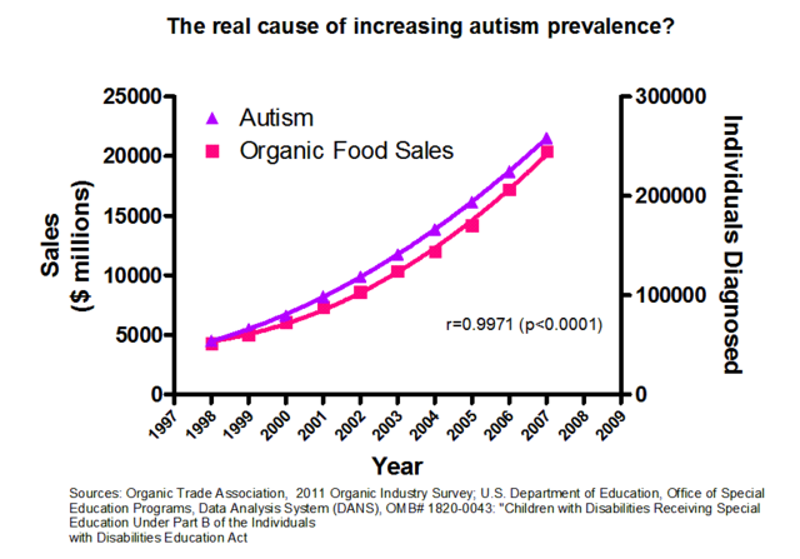
On correlation, causation, and the "real" cause of autismCorrelation implies causation is a major backing from people who rely on anecdotal evidence. As you should already know, correlation and causation have to be very carefully studied before any conclusions are drawn. Which is a major problem with media reporting on how certain things cause cancer, there’s a good chance that there isn’t actually a correlation. For an image representation of this, I found a website describing a reddit user who correlated the incline in organic food sales correspond to the diagnosis of autism. Do what that what you will, but I whole heartedly don’t think for a fraction of a second there is a link, but many people would if that word ‘organic’ was replaced with ‘GMO’.

So anecdotal evidence doesn’t hurt right?

Two words: product testimonial. You know these right? Arthur from Stockport has had problems with weight for years, he found this new natural remedy to be pushed down his throat by ridiculous claims of miracle weight loss. He’s (poorly) telling you his story of how after 4 weeks he lost 12 stone, but neglects telling you about the drastic surgery and dieting. You will have seen these ridiculous infomercials at some point. Does this hurt anyone? Well, yes, people will:

a)    Purchase the remedies, which tend to have no statistical and/or clinical significance and have an adverse reaction
b)    Rapidly loose weight by starving themselves, which can lead to further complications
c)     They don’t actually work. Which can lead to issues psychologically and cause drastic decisions, e.g. unnecessary surgery.

I could write a whole post on weight loss supplements, but I’ll leave it at that.

imageIt would be benighted of me to not state out the obvious cases of anecdotal evidence pushed by a groups of pseudoscientific morons; the anti-vaccination movement. They use anecdotal evidence to fearmong about the development of autism in vaccinated children. They use a non-existent correlation to fight their cause and ignore the evidence; there is no link. I mean, there are countless issues with using the anecdote ‘my child got autism from a vaccine’, and I cannot even fathom to go through them. And yes, people actually die because they don’t get their children vaccinated based on anecdotal evidence. What a privileged first world we live in, eh?

Conclusion

Essentially anecdotal evidence is a story told by someone. It tends to go against the proper scientific medicine by replacing large samples for small biased samples; rely on observation rather than statistical data; discount variables as opposed to controlling them and finds trends that link to their preconceived notions as opposed to well, not. If you find yourself in a situation where someone says ‘a friend of a friend tried’ or ‘well this worked for me’ followed by something absurd, tell them to shut up or switch yourself off. Anecdotal evidence is not evidence, its mostly pushed on by people trying to sell you pseudoscience. Trust me, you don't want to buy it - see what I did there?

Saturday, 16 April 2016

Here We Goop Again


The Dirty of Lying

TEDx:  Distinguishing Science from Pseudoscience and Bad Science
I was pointed to an article on the Goop website. If you recall, goop is a website set up and run by actress Gwyneth Paltrow, and is rife with pseudoscience. This website, or rather her pseudoscientific beliefs, have gained a lot more media attention over the last 6 months. From, sex dust to bone broth there is nothing this woman cannot cure with organic, natural ‘chemical-free’ ingredients. The post I was pointed to was an article entitled ‘The Dirty on Getting Clean’. If you can be bothered to read it, you will see it is just really a ploy to promote brands and misinformation, as far as I am aware.


"Something about this didn’t sit right with Gregg Renfrew, who found that the more she learned, the more she realized what she didn’t know—and the more scared, and angry, she became"


Well, what didn’t she know? A whole lot it turns out, and it appears she didn’t actually learn that much either. She released a brand called ‘Beautycounter’ to free our skin of toxic chemicals – whatever the hell that means, dose makes the poison – all chemicals are toxic at the right dose – kind of getting bored of saying this. Of course she wouldn’t know any of this, she has no formal scientific education or training, but hey, why not weigh in on it anyway. 


Fabricated statistics


One sentence really annoyed me, and it is a common theme within pseudoscientists pushing an agenda; fabricated statistics. We are all prone to saying fallacious statistics in our everyday life “9/10 I do it” or “90% of the time” – that’s fine, it is only everyday hyperbole, and no one is regulating that. When you have a platform however, it gets a little sketchy. People are listening, reading and watching your every word. Even sadder, people are listening to it and running with it as fact. 

hqdefault“80% of the chemicals in personal care products have never been tested for safety,” she explains. “It’s an unconscionable fact, and we all deserve better.””


Okay, that sounds like something people would believe. Is it true? Well, lets look at what the Food and Drug Administration (FDA) says on cosmetics. They state that they as it is not a food or a drug, meaning they don’t have legal authority over it (with the exception of colour additives). However, they can, and do, enforce legal action on products that are not in compliance with the law. So, if you manufacture a product, you can put whatever you want in it providing it isn’t a food or a drug, they have a point in that. However, to market and sell the product, you must ensure it complies with:

  • The ingredient and the finished cosmetic are safe under labeled or customary conditions of use
  • The product is properly labeled, and
  • The use of the ingredient does not otherwise cause the cosmetic to be adulterated or misbranded under the laws that FDA enforces.


The first point is the one I was expecting, basically saying, you cannot put anything in there that is going to harm anyone. Fair enough, I’ll take the cyanide out of this is now. So then comes the statistics, are 80% of the chemicals in personal care products unregulated? Hmm, I can’t find any actual authority on that, not one scientific paper, not one shred of evidence. Not one. I type in an array of sentences to find this, all I get is links to this article or other articles by Greg Renfrew, and she’s definitely not an authority on this subject. So, until she provides a list entailing 80% of the ingredients in cosmetics are unregulated, this is a blatant fabrication. 


Ridiculous Claims

Where there’s pseudoscience there follows the increased risk of cancer, autism and any disease you cannot cure without organic extracts. Yes, she genuinely claims autism is on the ‘rise’.

“One in two men, and one in three women will be diagnosed with cancer,” Renfrew explains, “while one in three kids will be diagnosed with ADHD, asthma, autism, or allergies.” She goes on to add: “What’s happening in our genes, physical environment, food supply chain, and cosmetics is a complicated dance. But our skin is our largest organ—it’s silly to assume that toxic chemicals we already know are linked to health problems, or chemicals that are understudied, aren’t having profound effect on our health, especially when so many illnesses are on the rise.”


Yes, it is a complicated dance. A dance you have not bothered to learn. This is fearmongering at its worst. If you use cosmetic products that aren’t purchased from my “safe” regulated company, then you will get cancer or autism. Excellent. She doesn’t back this up with any scientific information at all. The actual statistics on autism are about 1 in 100, not 1 in 3. Then we have to call into question the reason for the small increase in registered austism cases. A lot more people are aware of the condition and it is a lot more regularly diagnosed on the 'spectrum' compared to 16 years ago. It could be that more people are being diagnosed with autism, not that more people are having the condition.


Mock News with Bob Shiefer
She goes on to mention in a recent ‘study’ they found parabens in breast tumours at the same concentrations as in cosmetics. Because that’s how the body works. And she doesn’t even link to the study, she links to an interpretation of the study. Same concentration as in cosmetics is an absurd notion, anything that goes in at a certain concentration, is the same as when it is detected? We don’t even use that in forensic toxicology for a reason, your body breaks things down and excretes them. Not to mention, are all parabens at the same concentration throughout cosmetics? The study was published in Journal of Applied Toxicology titled Concentrations of parabens in human breast tumours, they conclude:


These studies demonstrate that parabens can be found intact in the human breast and this should open the way technically for more detailed information to be obtained on body burdens of parabens and in particular whether body burdens are different in cancer from those in normal tissues.


Using 20 subjects, that’s a conclusion alright. More work needs to be conducted looking into “the burdens of the body” – cannot even fathom what that means. The study does not even show that parabens cause cancer or even that are at all harmful, just that they were present. Even more, they didn't even have a control group. They just looked at parabens in the bodies of 20 deceased humans. What about possible paraben levels in normal tissues?

What are these 80% of chemicals?


It gets you thinking, right? If she is so quick to announce this revelation she has found out, she should surely publish this. Well, I can’t find any published ingredient list that holds any water with how nasty these chemicals actually are and/or if they are unregulated. In fact, I find the opposite, such as lists of chemicals in them and the efficacy. Here is a list of common chemicals used in cosmetics, which have studies into toxicity and LD50 (lethal doses) – just don’t use more. Lest you forget, even water, caffeine and alcohol have lethal doses. Everything does. Sadly, and to my disgust, this is why we have animal testing, to test the cosmetics on animals to see if they are affected. I am, by the way, in no way condoning this, it is genuinely vile.

Chemikillz


I wrote a post on a company called Lush recently, more accurately, two pseudoscientists who use big chemical names to fearmong. Which is exactly what is carried out in this post on goop. There is very little substance to the claims and no scientific evidence to back this up. Using chemical names makes things sound scarier than they are. We all know dihydrogen monoxide is water, but the chemical name sounds much more terrifying. There is genuinely no need for this, other than to market and promote your own business. She weighs in on how chemicals in our cleaning products are harming us. Saying don’t use plastics with type 3, 6 or 7. I can only imagine she is getting her ‘scientific’ information from Mercola, who claims that PVC (plastic 3) can make men turn into women as it is a “gender-bending” chemical. Seriously. 
 

If You're Citing Mercola, Natural News, or Dr. Oz As Your Evidence you're gonna have a bad time - If You're Citing Mercola, Natural News, or Dr. Oz As Your Evidence you're gonna have a bad time  Youre gonna have a bad time"Phthalates are one of the groups of "gender-bending" chemicals causing males of many species to become more female."


Then we have authoritative speculation:
 

“Non-stick cookware may be coated with Perfluorooctanoic acid (PFOA), a chemical that may cause cancer,”


May or does? I may get hit by a car, should I go outside? I don’t see anything in the way of scientific evidence, once again, to say that PFOA causes cancer, and neither does she. She recommends you use fabric shower curtains because the volatile organic compounds enter the air, complete with a link to the centre for health, environment and justice – although the link doesn’t work.


Conclusion


Chemicals are all around you, you consume them every. Single. Day. You do this in order to stay alive. When people who have absolutely zero scientific knowledge or training to spot pseudoscience or manipulated/fabricated statistics have an ‘opinion’ (no matter how bloody authoritative they put it across) on these matters, I implore you not to listen. If you do listen, then research. There is a hell of a lot of good that comes from raising questions, but when you get an answer to that question that doesn’t conform with your pre-conceived notions and you get all campaigny about ‘truth’ and ‘cover ups’, then we have an issue. There is ample science out there to dismiss these claims, yet businesses have been built around it, based on fearmongering. Maybe, just maybe I’m on the wrong side of this, just think how many millions I could make by selling ‘chemical-free’ bullshit.

Saturday, 2 April 2016

Can Cannabis Help Diabetics?


Diabetes and Cannabis

Marijuana diabetes
 I have seen this relationship between cannabis and diabetes pop up quite frequently now, both in work and within social media. I tend to have not given it much credence after looking to see if I can find a good amount of credible research in the area previously, I didn’t yield too much. However, yesterday diabetes UK decided to post a link to an article written on their website, with implications that cannabis can be used to control diabetes better. I know that this is what they were implying by the comments on the article published, mostly people asking if this was true and whether cannabis can be used to help with diabetes. Sadly, these genuine questions were met with ‘I’ve been taking it for years and it has helped me’ or ‘of course it does, big pharma wont pay as it helps too much and they make money from this’ – because no one who works in the pharmaceutical industry will have diabetes.

Diabetes UK - Cannabis and Diabetes

It appears that diabetes UK jumps on every avenue to promote anything to do with diabetes, and I mean anything. Shortly after publishing the cannabis and diabetes post, they published a post showing a link between aloe vera and better blood sugars, something that I wrote about recently, that has very little scientific evidence. The cannabis post itself appears to be somewhat informative but also quite lacking in information. They say that cannabis causes ‘mild’ physical and mental symptoms in subjects – when compared to other drugs. Which is like saying that vinegar is safe to drink by the litre when compared to chloroform.  They neglect to mention that heavy and prolonged use can lead to paranoia or psychotic states which require hospitalisation. But hey, at least they stress the fact that no one has ever died from cannabis use.  It would be interesting to know how many people had died as secondary result of cannabis ingestion, e.g: careless driving. They state that there is direct evidence for cannabis reducing inflammation and direct evidence to state that type II diabetes is caused by inflammation, something of which is highly based of scientific speculation at this point in time. They go through listing different types of studies looking at diabetes related illness from neuropathy to blood sugar control whilst heavily putting emphasis on one particular…*ahem* “published study”.

Study

Well, I play it fast and loose with the word ‘study’, I’m going to call it a ‘post’ from here on. The post was published on and by ‘AAMC’, the American Alliance for Medical Cannabis (also referred to here as a 'published study'. Seriously). If red flags haven’t appeared already in your mind, you are in the right place. And it was indeed a post, not a study. It was essentially un-referenced information about what cannabis can allegedly do – I don’t have the time, nor the patience, to go through all of the information. They may as well have written it on a lamppost for all I care, it appeared overly idealistic. Any stories of cannabis regulating blood sugar is purely anecdotal at this point, which is, to their credit, disclosed. Surely, this is careless of diabetes UK to propagate, this is so far removed from a study it is ridiculous.

Any Evidence?

shutterstock_171358868Is there any evidence that cannabis can help regulate blood sugars? When people strongly believe something, they tend to focus on one particular paper that confirms and conforms with their views, even if this is one study saying the opposite of thousands, commonly seen with homeopathy or accupuncture. So it comes as no surprise that I see a particular paper associated with this over and over again, which I had never read, until yesterday evening, that is. Many of the pro-cannabis groups really propel and reference to this paper to emphasise the effects of cannabis on diabetes. The American Journal of Medicine published a study in 2013 entitled: The impact of marijuana use on glucose, insulin and insulin resistance among US adults – this is an open access paper, so you can go read this for yourselves. They conclude that marijuana use was associated with lower fasting insulin and Homeostatic Model Assessment (Insulin Resistance) (HOMA-IR), which is essentially a quantification of the beta-cell production (insulin secretion) and insulin resistance - but this model itself isn't without its issues according to the American Diabetic Association.

This is really one of the only studies looking at cannabis use on blood glucose regulation, which they appear to pride themselves on. They gather 4657 people and self-assess their cannabis use by they asked three questions:

·       Have you ever, even once smoked marijuana or Hashish?
·       How long has it been since you last consumed marijuana or hashish?
·       During the previous 30 days, on how many days did you use marijuana or hashish?

When you study using subjects using self reporting data you have to ask yourself, how reliable is the information? Well, when you are dealing with people who are doing drugs, how accurate is the information? Do they remember how much they had? When they had it exactly? How many ‘drags’ of a ‘joint’? A myriad of questions pop up here. Nevertheless the study divided them into groups of never used (n=2103), past users (n=1975) and current users (smoked in the last 30 days, n=579). These groups were then tested to find the HOMA-IR and fasting insulin levels. They compared this to subjects’ information from a previous medical examination in 2010 and between the groups. They found that glucose levels were higher in those that had never (reportedly) used cannabis (103.5mg/Dl) and lower in those that were currently using (99.7mg/Dl). Astonishingly, they also use and reference to HbA1c levels being lower, by 0.1 (5.5 in those never used and 5.4 in those past and current). This is the average blood sugar over 8-12 weeks. Comparing that to information from 2010 will tell you nothing really about an overall group of people.

We have almost as 4 times as many subjects in ‘never used’ compared to the ‘currently using’, which is going to bias the numbers, right? Especially in something as varied as blood sugar. The 'used cannabis' group is anyone who has consumed cannabis, but not in the last 30 days. If you used it for example 4 years previously, once, you would be put into the 'used cannabis group'. Are we saying that one use of cannabis, for example a smoke of a 'joint' is enough to say that cannabis helps even 4 years after? Or is it the fact we have less subjects and that have used compared to the 'never' group, so there is less number variation, bringing the average down? My bets on the latter of the two. 

The study also provides statistics where we adjust multi-variable (they don't state which) excluding diabetics, which makes you ask the question, how many of the subjects in this study, assessing diabetic care with cannabis, were diabetic? What type or diabetes did they have? We have no clue, because the information isn’t provided or even hinted at. Then we get to a couple of sentences within their discussion section which read:

“In addition, data on marijuana use were self-reported and may be subject to under- estimation or denial of illicit drug use. However, underestimation of drug use would likely yield results biased toward observing no association.”
http://nsfconsulting.com.au/wp-content/uploads/2014/04/Screen-shot-2014-04-13-at-5.10.58-PM-446x316.pngWhy would it be only underestimated? Why are we assuming they are not overestimating? Evermore, the sentence following shows some heavy bias. They state in the beginning of the study that little work has been done in this area and this is the first research of this kind. So why would we expect to see results biased toward no association? Why wouldn’t we see results that show the opposite, that is; there is an opposite effect to what they were looking for – cannabis makes diabetes worse. This shows they were looking for a correlation of 'cannabis makes you loose weight and effectively lowers your overall blood sugar levels and insulin resistance' effectively saying;  the cannabis could only improve diabetes or it wouldn’t make a difference at all. Their hypothesis that it would improve diabetes hasn't been proven correct, when you look at the numbers, you don’t have a staggering difference between them, even if you ignore the biased amount of subjects in each group, there are still a lot of variables. The average HbA1c levels within the subjects (5.5-5.4%) are very good to say the subjects are diabetic, suggesting they have it under control with medical intervention or are type II subjects with good physical fitness and healthy eating habits. Another major questions in studies such as this is what was the concentration? They weren't all consuming the same batch of cannabis from the same plant, so there is going to be a significant difference in the levels of THC in the cannabis itself. In 2008, the Home Office released a study (PDF) stating that in 2007 the average cannabis potency of cannabis was 4.1-47%. Not only is this a large range, there is a high probability that they won't be ingesting the same form or strain and thus the same potency with each use. It is also improbable that they have remembered every consumption over their life-time, let alone the exact amount being consumed.

So to summarise this study, we have:
    http://cdn.meme.am/instances/500x/64545163.jpg
  • No indication of the type of diabetes. Type one is insulin not being secreted, whereas type two is insulin resistance, which is what they are reviewing.
  • Manipulated data and say that they exclude diabetics in a statistical analysis, but no mention of the population that is diabetic.
  • Self reported data, not accurate.
  • 4 times as many of the control (never smoked) as the current users, and twice as many as the past users leading to biased results with large gaps in the 'used previously' category. 
  • Half of the subjects self-reported they were inactive, 41.1% of which were in the ‘never smoked’ control category. Exercise is proven to help with diabetes and weight loss. This could be a direct correlation which isn’t assessed in the study.
  • Average HbA1c levels amount subjects (5.5-5.4%) are very good, showing that the diabetes is already well controlled.   
  • How strong is this cannabis? What is the dose? There are a lot of unanswered questions here with a high amount of unattended variables.
  • High inaccuracy in results, it is hard to see where comparisons are being drawn between numbers

I appreciate a study with something of this nature cannot really be carried out within reason, that is just drugging people and checking their HbA1c levels.  However, there are institutions in places where cannabis is legal, maybe there’s a good starting point to make for a much more accurate and reliable study.

Conclusion

If you live in the UK, the source for diabetic care should really be focused on Diabetes.org.uk, as they appear to be much better at scientific communication and don’t appear to jump on every scientific story involving the word ‘diabetes’. Any stories of cannabis helping with diabetes are purely anecdotal, which isn’t really evidence. Much like the subjects in the American Journal of Medicine use anecdotal information to recollect the use of cannabis. Anecdotal evidence isn’t clinical evidence, and with that it is irresponsible of a website promoting awareness and giving a platform for people with an illness to propagate such misinformation. The section on cannabis in the diabetes.org gives a much more accurate representation of the effects and the effects on people with diabetes. Raising the point that if you are taking cannabis you can get spaced out and forget to take medication and if you get the munchies, your blood-sugar is going to rise. To diabetes UK’s credit, they do have this information at the bottom of the page, bottom, after telling you how many ways it can help you with bogus 'studies'.