Search This Blog

Thursday, 18 August 2016

Paracetamol and Pregnancy


Is Paracetamol the Cause for ADHD and Autism?

If you have picked up a newspaper or watched the daytime news, at some point, you will have seen this article on how the risk of hyperactivity disorders and autism is increased when paracetamol (acetominophen) is consumed post-birth. The media jump on the fearmongering wholeheartedly, but, thankfully, much of this is met with a slight amount of scepticism.

paracetamol
“Mothers-to-be who take paracetamol are more likely to have children with behavioural problems, new research suggests. Scientists have found an association between mothers who took the drug in the first and third trimester of pregnancy and hyperactivity and emotional problems in their seven-year-old children. Paracetamol is the world’s most popular painkiller and is the only one deemed safe to take during pregnancy. But there is a growing body of research suggesting it could affect the development of children in the womb, with studies linking it with conditions as diverse as asthma, infertility and autism.”

This section was taken directly from the Daily Mail and contains quite the loaded gun, paracetamol causes hyperactivity, emotional problems, infertility and autism – at least it’s not vaccines this time, eh?

Study time

So, why did this bull come about? Researchers at the University of Bristol published a study showing collaborated the records of 7796 between 1991 and 1992 along with their children and partners. They asked the mothers if and how much paracetamol they had consumed at 18 and 32 weeks of pregnancy. They’re conclusions go:

"In this study, we have demonstrated that children exposed prenatally to acetaminophen in the second and third trimesters are at increased risk of multiple behavioural difficulties, including hyperactivity and conduct problems."

AVOIDBIASSo, they asked them on a questionnaire, which we all know isn’t renowned for its accuracy. We are already starting with somewhat skewed results. We have 7796 records, but how many children? Well, we had a grand total of 14062 children.  That’s quite a good number for a study. Paracetamol use was reported by 6916 mothers, 5% of the children in this went on to have behavioural problems. I can’t see an actual figure of how many children went on to have ‘behavioural problems’, and I don’t have enough information to work that out. But, let’s say that each of the people who didn’t take paracetamol had one child. This would leave us with a study group of 13182 – leaving us with 659 children with behavioural problems. Which, in the grand scheme of the study, is not very much. They then talk about a relative risk (I’ll discuss later on what this is) of a rate of 5.6% chance of behavioural problems in mothers consuming paracetamol and 4.8% in those who didn’t. So we are comparing two groups, 880 mothers against 6916 and we have a result to conclude that, relatively, paracetamol causes ADHD…I think not. 

Autism

A study released earlier in the year entitled: Acetaminophen use in pregnancy and neurodevelopment: attention function and autism spectrum symptoms published in the International Journal of epidemiology followed a similar sort of layout for the above study. They found that of the 2544 subjects, only 43% of those children who had exposure to paracetamol whilst in the womb, giving a total figure of 1093 subjects. They conclude that there is a causational link between paracetamol and autism, just from those 1093 subjects.


Again we have another study in the JAMA Paediatrics linking paracetamol use and ADHD or hyperkinetic disorders in children. They asked 64322 pregnant women which painkillers they had used and a result of 56% (n=36020) admitting to consuming paracetamol. They conclude that 29% of children were more likely to be taking ADHD medications and 7% were more likely to show ‘observed ADHD symptoms’. This study also, like the others only talks about relative risk. Now, this is quite tricky to explain and there is an excellent video here. Basically; absolute risk is the risk of a disease developing and relative is the comparison from two groups of people (this is broken down a lot). In the results they sat that ADHD behaviour was observed (however broad that may be) at the age of seven in 2.5% of the mothers who didn’t consume paracetamol and 3.4% for those that did consume paracetamol. Is that a huge difference? The answer is no, which is not a statistically significant difference to make a conclusion on. We, as I mentioned, are talking about ‘observed behaviours’ of ADHD, how about an actual diagnosis to base some actual statistics off of?

Asthma

This appears to be one that is ‘proven’ to be settled, that consuming paracetamol whilst pregnant increases the risk of asthma in the child. However, this is far from settled. I am lucky enough to have located a meta-analysis on this particular subject. In the review of the literature they state that the weight of the studies collected strongly suggests various forms of bias, including cofounding by indication. This is a whole issue in these kinds of studies. This means that a variable is a risk factor and they are looking for something to pin that on whilst they haven’t looked at any intermediate steps or causal pathway to say that this proves this. To make that clear, they are saying paracetamol (the variable) is causing autism (the associated exposure). They could just as easily say ‘it’s the water they have drunk whilst pregnant’ – why and how?


Conclusion

Let’s think about this for a few moments. Many associational studies, the evidence is riddled with methodological bias – they’re basing their answers on a questionnaire, this carries a massive risk, even the systematic review on asthma says so. The studies show positive trends between paracetamol and development problems in children – but did these people not do anything else? What about sugar, other medications, drugs, alcohol, socio-economic status and the crux of it, genetic factors? There are so many variables here that you cannot make such baseless claims on the back of questionnaires. There could be a link, then again, maybe not. Lets not forget, these are few and far between studies, the only one that has had a systematic review carried out on it is the one an asthma, and the jury is still out on that one. The general consensus here is to not be scared to take paracetamol as needed when pregnant. 

Wednesday, 27 July 2016

Is Isoflavone Better Than Chemotherapy?


Cancer? Have some Parsley and Dill

https://foodscienceinstitute.files.wordpress.com/2015/11/parsley.jpgWe have long seen and heard of supplements and herbs and ‘natural’ remedies that can cure any disease you have, including cancer. It irks me when I see headlines such as “Parsley and Dill could besafer than chemo”. Nevertheless, if you remember my previous blog on a magazine I had discovered called 'What Doctors Don't Tell You' - this is the headline they decided to run with. The article focuses on a study published in the Journal of Natural Products, Yes, that is apparently a real journal. Which has an impact factor of 3.7 (in 2014), ridiculously low – meaning it would be easy to get something published in there and what is published in there, really isn’t of much value to the world of actual science, shockingly.

Isoflavone

The article places focus on Isoflavone; a naturally occurring phenol, often referred to as phytoestrogens due to their biological activity effecting the estrogen receptors. Soy beans are a great source of isoflavones, for example. I should point out here that Isoflavone is a very broad term, very broad. What is quite remarkable about these is that they are relatively untested for safety and efficacy. Obviously as they are naturally occurring, organic shills will jump on this avenue claiming ridiculously stupid, untested benefits. It was only last year, after all, that one of the isoflavinoids was identified to cause biliary atresia when infants were exposed to it. 

The main focal point is placed on the isoflavone glaziovainin A. So, lets take a look at this thought provoking, innovative study entitled: Efficient Synthesis of Glaziovianin A isoflavone Series from Dill and Parsley Extracts and Their in Vitro/In Vivo Antimimotic Activity. Well, there isn’t much to say, other than that they are really looking more at the pathways of biological metabolism. There is no conclusive proof of anything, not even the pathways they appear to have produced. Yet, the author, Alex Kiselev, of the paper states:

how-to-spot-bullshit-science-4-common-mistakes 
"Both improvement of existing therapies and search for innovative approaches are essential components of a quest to treat cancer. Our combined team developed a simple method of producing glaziovianin A and its structural analogs, which inhibit the growth of human tumor cells, using feasible building blocks from nature. Furthermore, evaluation of these novel agents in vivo using our validated sea urchin embryo assays yielded several promising candidates selectively affecting tubulin dynamics"

I don’t know who has ‘validated’ this assay that they are speaking of, but they most certainly did not ‘cure cancer’. My main issue here is not the bad science, that’s pretty much a standard in this day and age - and sadly, it will be around forever. My issue is the marketing of the articles and the claims made by the author, the findings do not, in any way, fit the conclusion that ‘eating dill and parsley is better for you than chemotherapy’. Yes, chemotherapy is intense and has some nasty side effects, but the cost of refusing treatment and eating isoflavones would be a lot direr. The study does not compare the efficacy of isoflavones as a cure for cancer in a human model, nor does it compare to chemotherapy success rates. So, if you have cancer and favour more natural remedies over chemo, don’t. If this was a study of high quality and value, why are we only seeing it published in an extremely low impact factor journal? Why not the New England Journal of Medicine or Nature? Does a double blind controlled experiment mean nothing to these people? There is not much data on the adverse effects of isoflavones, they are most commonly poured into the supplement industry and shoved down the throats of consumers as ‘natural remedies’. In evidence lies truth – and there is just no evidence here. 


I did however, find some light in all of this. I found a website mimicking 'what doctors don't tell you' magazine covers, such as:

Conclusion

To claim that you have conducted a study that has produced a cure for one of the most horrific diseases is one thing. To claim you can pit it against the one thing we know can destroy cancer cells is another. To claim that it works better, that is just absurd. How these ‘scientists’ and the media get away with producing and marketing such articles is unfathomable. The naturalistic fallacy of 'natural means healthy' really has to be stopped and is so misunderstood amongst the general population - that is what these people play on. I implore you not to listen to them and read actual evidence and science based medicine, not the pseudoscientific bullshit that these despicable quacks have produced.

Sunday, 12 June 2016

Watch out for that Quack…Vegan Special


How Thin is the 'veganism cures cancer' Argument?


Cancer Cured HeadlineCan veganism save your life? I have been told a vegan diet will cure diabetes (actually, this guy said it would cure the ‘genetic weakness’ leading to diabetes), make us live longer, cure any ailment and even prevent cancer. Wow, just doing that with a diet, I would be healthy and then I can live my life freely…but wait, I have been a vegetarian for 13 years now, I think ‘well, I’m halfway there and I have developed diabetes’, so it’s probably not going to help. This moron, sorry, acquaintance of my sister, posts hilariously biased and improperly sourced articles to back up whatever aligns his preconceived notions to support his lack of critical thinking and lack of basic scientific education. This hits home, as we went to the same schools, only I, clearly paid attention. 

In a long string of posts this guy places this article entitled: Scientist find blood from vegans is eight times more protective against cancer. 

The article summarises a study saying:

In a series of experiments people were placed on different diets and their blood was then dripped on cancer cells in a petri dish to see which diet resulted in blood that was more effective at suppressing cancer growth.

This is about as telling as pinpointing which water molecule finally sank the Titanic. If it does it in a petri-dish it is exactly the same in the body, right? 


Studies…

The first study they link to is published in The Journal of Urology titled: Intensive lifestyle changes may affect the progression of prostate cancer. Using 93 volunteers they looked at the effects of lifestyle on PSA. I have previously written about why PSA is not a reliable source of information in my post on screening. They state that the growth of cancer cells in the prostrate was inhibited by almost 8 times as much as the control group. There is no mention of veganism in this lifestyle change. So this is redundant. 


CC-BY Michael J. Ermarth“Subsequent studies against breast cancer showed the power of eating plants for just two weeks.[2]. ..Samples of blood were taken from women with breast cancer, and then the women were asked to spend 14 days on a plant-based diet and perform 30-60 minutes of light exercise daily. After 14 days their blood was taken again and found to significantly slow down the growth of cancer, as well as increase the blood's ability to kill cancer cells.

So, this study they cite actually looked at effects of diet and exercise on known breast cancer risk factors. They do not mention anywhere in the study that these women have cancer. The women were placed on a low fat and high fibre diet and exercised. The conclusion of the study is literally:

These results show that a very-low-fat, high-fiber diet combined with daily exercise results in major reductions in risk factors for BCa while subjects remained overweight/obese. These in vivo serum changes slowed the growth and induced apoptosis in serum-stimulated BCa cell lines in vitro.

I have no idea what the person who wrote this article actually read, but it was clearly not the study they have actually cited. Now, I am not saying he’s made this up, maybe he just can’t read? This literally has zero all to do with veganism. Zero. Like the last study. 

They then say that maybe it was the exercise that did it, so a separate study was set up – good line of thinking If the premise was even true, credit where it is due when trying to cover your own back and trying to give legitimacy to bullshit. So, they provide and third and final study published in prostrate titled: A low-fat diet and/or strenuous exercise alters the IGF axis in vivo and reduces prostrate tumor cell growth in vitro. The study, again, mentions low fat and healthier diets, not veganism and didn't really show much clinical significance.

The article concludes with:

Lifestyle changes can have a huge effect on our long term health and reduce the risk of contracting cancer and increase the chances of surviving cancer. A plant-based diet and regular exercise can really help improve our long term quality of life. And having blood that's more inhospitable to cancer growth is just one major health advantage of the vegan diet.

Now, the only way I think they can conclude this is if they have used ‘high-fibre’ and ‘low-fat’ synonymously with ‘vegan’, and I believe they have just done that. These studies show, in low sample sizes, that exercise may have an influence on cancer prevention. Not one study describes a mechanism as to how cancer is ‘inhospitable’ in the blood of vegans (because it isn’t). The premise is that vegans don’t get cancer and that really does not fit any scientific consensus. 

Hilariously the author of the post dumps a picture in the centre to highlight how good veganism is :

 
Does this mean anything to you? because it doesn't to me and there is literally no mention of it in the main body of text. I have genuinely no idea what it is. I can only assume that it is the '8 times cancer preventative property', but I can only guess at that. The words 'S.A.D' and 'Vegan' have been presumably added by the author, as there is a key next to it. No title, but a key, what more information is needed?

Pandemic Immunity

Their conclusion in the article got me thinking, if their premise is true and vegans have blood that is ‘inhospitable to cancer growth’, then surely a blood transfusion would take hold to prevent cancer in people who are not vegan? Like when you’re watching a pandemic apocalypse film and they need the blood of patient zero to give immunity to a whole bunch of people in order to save their lives. I just had a quick search for any study in this area and there is none…wonder why?
immune system
[DO NOT BLOODY TRY THIS]

Where Do We Go From Here?

Stop saying it will cure cancer, symptoms of chemo, diseases and stope generally being morons. That’s pretty much where we go from here. If veganism really did kill cancer cells for whatever reason, do you not think more people will be vegans? Why do oncologists not recommend a vegan diet as treatment to their patients? There isn’t even a fallacy here for me to spout some Latin off; this is just purely made up. 

Cancer is pretty horrific in itself; medical interventions have been developed to help fight cancer. Years of study and scientific revolution has occurred in that period in order to help which these advancement. Not once has ‘I’m a vegan’ helped. The promise of a cure looks somewhat tempting, but there is no science behind this. Cancer is saliently complex and cannot be reduced to a couple of risk factors. This kind of message that people put out is dangerous and can put people at risk from receiving actual medical intervention. 

So, to summerise:
There is no evidence to say that vegan diets cure cancer. Not one. If you want to be vegan, that's fine. If you want to be a pseudoscience....that's not.

Sunday, 8 May 2016

The Coke Myth and the Renegade Who Generated it


Share a Coke With: A Quack
 Diet Coke

It appears that the infographic of ‘what happens 30 minutes after a can of coke is consumed’ appears to be circulating the internet again. However, although I heard a lot about it, I had missed the story the first time round last year and then completely forgotten about it. The graphic itself is produced by The Renegade Pharmacist, and spun into action by the Daily Mail and, of course, Natural News. The Renegade pharmacist, apparently, was a ‘licensed drug dealer’-turned good after witnessing how many drugs were prescribed each month. Isn’t it marvellous that we live in such a world that we can reject and go against conventional medicine based on this notion?

Renegade Pharmacist

Let that name sink in. They are an outlaw for pharmacy. Essentially, the website is against getting better through actual medicine. The about section of the website gives a profile of Niraj Naik, he appears to be semi-famous for the coke-gate (that’s what I am calling this), and that is about it. Before we talk about that, I’m going to point out the fallacies and riddles in his very own biography. First of all, “Certified Legal Drug Dealer” is a term they use for pharmacists, which is, technically correct. Its’ connotation however, that is not correct (using language to denote a deeper, sinister tone). They use the word ‘qualified’ and ‘certified’ about his pharmacy background, amping up the fact he has a pharmacological background, whilst at the same time calling them ‘drug dealers’ and demeaning the profession. Which is it?
 
“He also learnt of the debilitating side effects of the prescription medication which drove many of the patients to have to take more and more drugs to ease the side effects”

Errrrm...you really shouldn’t be giving people drugs for the side effects of drugs, unless they’re illicit drugs. So, lets not do that. As a pharmacist, how does he know the exact pathology as to why the patient requires the drugs? In other words, how on earth does he know that they are consuming more drugs to counteract the side effects of other drugs? So, after learning all this as a fully trained, qualified, certificated pharmacist, he decided (hopefully against his better judgment) to attend seminars on the ‘true origin of disease and prevention’ (I wouldn’t even know where to start in disseminating that title). Following this he swapped pharmacy for food, tools and websites to help people. The best line of all of this bio follows:

"After an arduous battle trying to get his novel approach accepted into the mainstream that resulted in a lot of stress and disillusionment, in 2010 he was diagnosed with a stress related illness, ulcerative colitis, that left him housebound for over 10 months."

This ‘arduous battle’ is no where near as rigorous and as regulated as the actual case of getting medicines from ideas to shelves. No where near. I wasn’t all to shocked to discover there is no evidence to say that ulcerative colitis is caused by stress. It is, however, caused by genetic and environmental factors. However, getting stressed can exacerbate the condition, but it is studied to be down to genetic factors and possibly environmental. Another case of Wikipedia being wrong and a story that ricochets with a little less than the truth from the offset.

Diet Cokegate

Yeah, the crux of this post. This guy is mostly famous for not knowing biology. No, errm... his highly scientific, dammit... his post of what happens when you consume diet coke. Let’s start from the beginning:

Diet Coke infographic 

10 minutes

Aspartame does not trick your body into thinking it has processed sugar. When digested, aspartame breaks down very quickly making phenylalanine and aspartic acid, hardly any enters the bloodstream. Which takes down the next part of the post saying aspartame triggers an insulin response. There is zero evidence of this, despite him saying something about there being studies on such things. I cannot find them, and believe me, I’ve tried. There are myriads of studies out there on sweeteners all with similar conclusions. For example published in the American Journal of Clinical Nutrition titled: Functional magnetic resonance imaging of human hypothalamic responses to sweet taste and calories 1’2’3:

"Glucose ingestion resulted in a prolonged and significant signal decrease in the upper hypothalamus (P < 0.05). Water, aspartame, and maltodextrin had no such effect."

As it doesn’t really enter the bloodstream, it would be quite impressive to illicit an insulin response.

20 minutes

In the original post by Niak, he cites some scientific studies. In this science game, it’s not just enough to cite them, you should probably read them too. The infograph above states that it is reported that there are higher risks of diabetes, high blood pressure and heart disease. The links he used to ‘back up’ these claims, actually don’t back them up. Each of the studies do not individually, or collectively, prove that the drinks cause any of these problems. At best, they show some association, there is a great difference between an association and a cause (pdf). Remember that whole ‘correlation doesn’t equal causation’? Yeah, apply that here, there and everywhere. There are a hell of a lot of factors involved in disease, singling it down to one cause and saying that there a 67% risk of increased diabetes is quite the stretch (even though only 8.2% of the subjects were identified to have got diabetes out of the 6814 subjects. I mean, that would only be a correlation if they consumed only diet coke and you would require more than two studies to back this up.

40 minutes

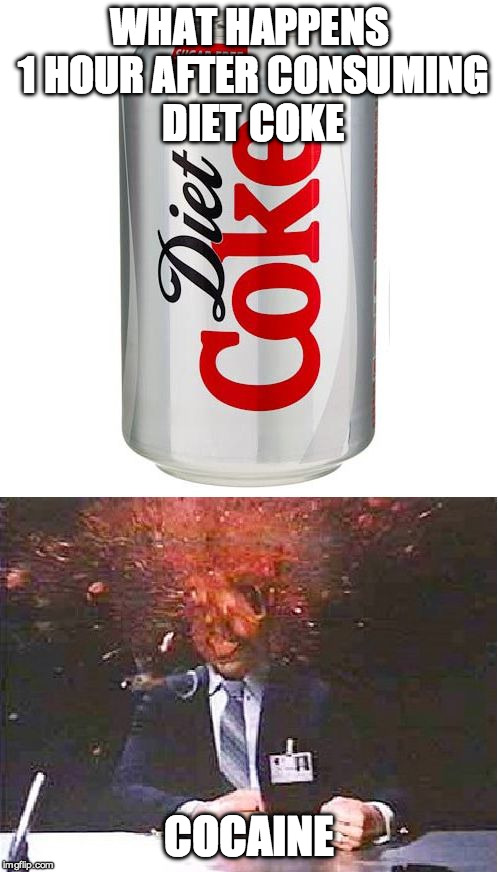
Addiction, that’s some powerful drink, eh? Potentially deadly combination of caffeine and aspartame, that’s new. So if I take sweetener in my ultra strong coffee, is that potentially deadly too? Why is only diet coke getting the bad rap here? Let put some scientific terminology in here ‘excitotoxin’ and ‘neuroreceptors’ and it sounds like hes’ done his research, or has he? A systematic review published in Critical Revolutionary Toxicology states:

"The studies provide no evidence to support an association between aspartame and cancer in any tissue. The weight of existing evidence is that aspartame is safe at current levels of consumption as a nonnutritive sweetener."

But his one source says it is deadly? No, it doesn’t even say that. And we are using some powerful and suggestive language here, yet again; cocaine. This guy is seemingly obsessed with drugs, why cocaine? If you drink coke, you may as well do cocaine, no other stimulate in the world could be compared to caffeine. Only cocaine.  

60 minutes

All your minerals are potentially depleted and you are craving more sugar and junk food. I drink diet coke and this never happens to me, maybe I am an anomaly or the science just isn’t there? I’m going to err on the latter, since the last points were highly incorrect. Yeah, there are more nutritious things out there, water for example, but I see no evidence of these causing cravings.


The Blog Post


So, it wasn’t enough for me that the basic fact of the reported biological processes was highly inaccurate. I wanted to know why he thought this acceptable? Well, he states on the post that:

"I found if people drink diet sodas they still get the same problems as people who drink normal soda."

As a pharmacist he is asking patients of the consumption of their drinks? That’s a little odd is it not? And then comes the pin in his ever-present lack of regard for science bubble;

"The research I found from other well respected scientists back up my claims up too and you will discover this in great detail in the new infographic and from this article."

Two words; confirmation bias. Got it, the entire thing is based on a fallacy, like all pseudoscience. "What I feel is shown to be true by these well respected scientists (I have no clue who is is talking about here) so it must be true". So he has gone out of his way to find studies that back up the claims he believes to be true. These studies are either highly preliminary or he has inferred a conclusion from them that just does not exist, in the same way that the media run with stories and in this case, did.

Conclusion 

Health experts say the information in this infographic is exaggerated.When you actually type the words ‘the research I found from other scientists back up my claims too’ you have kind of lost any credibility.  The conclusions drawn to make the ‘info’graph are not actually backed up by actual science. The entire renegade pharmacist website reeks of self-entitled, in touch with the earth, holistic anti-science.

I’ll leave you with this:

“He believes that the stress of modern living is the root cause of disease and poor health, and that treatment begins with self belief.”

So my diabetes and magnesium disorder is down to stress and not genetics? You may have become a renegade pharmacist, but you have become a regular quack.