Search This Blog

Showing posts with label Science. Show all posts

Thursday, 14 May 2015

Forensic Science – How much faith should we put in a broken justice system?


So yeah, I’m slightly late to jump on the wagon of criticism to the justice systems regarding hair analysis but here we go!

CSI: Have You Ruined Forensic Science?


 In April, the news hit the mainstream media that the justice department and the FBI stated that ‘nearly every’ examiner in the forensic units gave flawed testimonies in almost all trials. The experts overstated a ‘match’ in more than 95% of the nearly the 270 trials; favouring the prosecution. Of these, 32 of which were to serve the death penalty, 14 of which were killed. There is probably more to come, as the inquest is into 2000 cases overall. 

“The Justice Department and FBI have formally acknowledged that nearly every examiner in an elite FBI forensic unit gave flawed testimony in almost all trials in which they offered evidence against criminal defendants over more than a two-decade period before 2000.

Of 28 examiners with the FBI Laboratory’s microscopic hair comparison unit, 26 overstated forensic matches in ways that favoured prosecutors in more than 95 percent of the 268 trials reviewed so far, according to the National Association of Criminal Defense Lawyers (NACDL) and the Innocence Project, which are assisting the government with the country’s largest post-conviction review of questioned forensic evidence.”

Image result for Crime scene investigation
If this is on the whole a massive shock to you, then you really have too much faith in forensic science. The society we live in today expects a wide array of no holds barred forensic investigative techniques to any crime committed, more so in murder trials. As a student of forensic science, we are constantly (and rightly so) berated with the term ‘CSI effect’. This is the term used to describe how people put way too much stock and faith into forensic science due to the show, as the name suggests, Crime Scene Investigation. The ‘scientists’ on this show use whatever means necessary to obtain any information from trace evidence; instilling a false sense of security in any forensic evidence.

Subjectivity

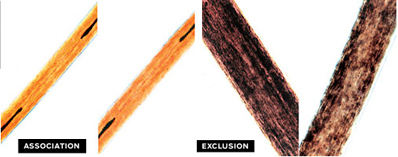
Now, I’m not stating that all forensic evidence is wrong per sae, but should come under much more scrutiny. When subjective evidence is found, much criticism should be used to avoid biases, most of which (I’d like to think) are more unintentional cognitive biases, rather than intentional misconduct. Hair analysis occurs subjectively, not much technical work is imparted into its analysis. Simply, a microscope is used to observe the hair structure. Thus, the problem with hair analysis is the overestimation of confidence placed on the ‘matches’ between a hair at a crime scene and the hair obtained from a suspect. Hair shows a large morphological variation: even in the same person.  The structure of hair is relatively simple, consisting of the medulla in the centre, the cortex surrounding it and then the ‘outer’ cuticle.  These ate the three features which are examined under a microscope – observing the colour and patterns.


 Image result for Hair comparison 


If the hair sample is found to be a ‘match’ that does not conclusively state that the hair sample came from only that individual – there could be a match to many more people. This means that there are a rather large number of false positives, which is seen here with the FBI. This is most certainly not limited to hair analysis; any subjective work will have a large number of false results. For example, take the work of Itel Dror, who went back and told fingerprint examiners that they had made a miss-identification and people had been proven innocent or guilty due to other evidence. Most examiners changed their view on the fingerprints; finding a match if they were told that the person did commit the crime (after previously stating no match without this information) and finding no match when told the person did not commit the crime (after stating a match without this information). This kind of bias, of course, has been brought up to higher forensic science regulators which suggest lines of debiasing techniques, such as the National Academy of Sciences (NAS) or over here in the UK: House of Commons Science and Technology Committee (SciTech) who partially suggest lines of scepticism towards more vigorous analysis of subjective evidence.

Conclusion

As we start a new government solely dedicated to a conservative party, what more will be done with a broken justice system? People have asked questions on the stance of forensic science prior to the General Election, yielding very little results; only UKIP and TUSC responding, which is very disconcerting.  

My main point here is; this isn’t new news. Biases have been known for many years, why has it taken so long to review the cases involving subjective evidence? Hair isn’t the only case here, we have bite marks, tyre marks, ballistics, handwriting, shoe marks, ear prints and as mentioned, fingerprints. Subjective analysis is a massive problem within criminal justice systems around the world’ leading to false convictions and mistrials. It’s excellent that this problem is gaining more media attention, highlighting the transparency that sciences saliently needs, especially when brought into a courtroom. Juries will overestimate the evidential value of evidence due to the CSI effect and overstating of confidences by expert witnesses. It would be beneficial to the justice system if shows such as CSI will address these issues, but I highly doubt it will. Therefore, is it for the government or the scientists to address the issues? Scientists have tried, very much so, to address bias involved in forensic sciences, but are these working with the CSI effect so vigilantly in place?

I can't say I blame CSI exactly, they haven't claimed to be accurate in their glamorization of a grim subject, but they also havent been forthcoming with how forensic science is actually conducted and appear to have literally zero spending restrictions. This effect is a product of yearning. Yearning for belief that moral and unbiased people are trying to clear the names of innocents and incarcerate the law breakers, note here, that life most certainly does not imitate art.

Wednesday, 29 October 2014

Are Skeptics Outcast? The world according to Michael....


I have been recently been reading up a lot on what people perceive to be a ‘skeptic’. In my mind, applying logical thought to processes that obtain evidence and giving the evidence rational. To others: Satan. Within the search I came across a website that really peeved me. The Michael teachings are a spiritual website, promoting…books from what I can gather. Although their ‘advanced topics’ section has some ‘interesting’ facts on the ‘7 planes of existence’.

"Michael channels work through many people at this time, and just about anyone, if they possess the proper desire and commitment, can learn to channel them."

Simple enough right? No, it gets more advanced. They can calculate ‘Soul Age’. What’s this you say? They define it as:

"Soul age refers to how a person has grown from experience on the planet, not just too how many lifetimes he or she has lived. No person is "ahead" or "behind" any other, but is simply occupying another place in the continuous circle leading to and from the Tao."

No one is in front or behind you say? Hmmm. Anyway, as you can probably gather my conclusion, the website is just pseudoscientific nonsense, I however, deliberately haven't actually read what they're about and what they do until I have written this blog about their view on skeptical activism:‘The Skeptic Attitude’ towards….well, thinking, one can only assume. They start off by generally listing ‘Positive traits’ and then ‘Negative Traits’, using terms such as ‘argumentative, lack of trust, making things difficult and picks things apart’. Lack of trust in what exactly? As a skeptic, I am not skeptic about everything I hear. I sit through countless lectures where I am bombarded with information, none of which I sit and think ‘I don’t believe any of this until I have thoroughly researched it’. However, when people who don’t know what they are talking about, and cannot get basic scientific facts correct, I do get skeptical, and annoyed. Skeptics do not question everything, I will read things, see things and hear things and think ‘something is off about that, I’ll have a look’.

"They are unconvinced until all the facts are in, and they dislike forming theories until the evidence has been thoroughly examined."

A basic scientific process is the ability to form a hypothesis based on the scientific information already available, the hypothesis is a theory on what should happen in the experiment, otherwise, why do it? Furthermore, why would you form a theory without all the evidence? Evidence is crucial to creating a theory otherwise, are you not just making stuff up? Such as spiritualistic mind and calculating soul ages? A scientific theory, isn't a theory in the sense of the word. It is the application of sound, solid science to draw a probability.

"They are the scoffers, the agnostics of the world."

I cannot speak for everyone out there, but surely the ‘evidence’ part of this blog would conclude that skeptics are atheists? Apparently not, but infer as you wish.


"This Attitude limits the sphere of knowledge that Skeptics believe, and the way they believe it: only objective knowledge is allowed. Subjective insights are not permitted — the subjective insights of others, that is….not considered valid by Skeptics unless they inherently believe in them or they have had convincing personal experience."

This is the sentence that got to me. Only objective knowledge is allowed. Well yes, why would you just take biased information as fact? If I said I was the best in the world at making risotto, would you not think to be a bit skeptical about that? It has come from me. I genuinely cannot see why being biased is a good thing. In a scientific world, subjective feelings don’t really apply. The scientific method really, really doesn’t require any input as to how you subjectively feel. As for the ‘inherited belief’ crap, I have read countless things that have believed to be wrong. I, even, believed in a God at one point in my life. 

"They regard others as strangers, and it takes a lot of time for them to befriend others…lacking in imagination….they see their illusions in the world rather than in their heads….they "project" their perceptions out there."

Just in case you could see through the bullcrap of the paragraphs before they switch it out to insulting. For me, the first sentence is true, I don’t befriend people. Mainly because there is a high statistical probability it will be someone like the person who came up with the Michael teachings, to save myself time and hassle, I just don’t bother. 

We project our perceptions out there, huh? YES OBVIOUSLY. THAT’S WHAT SCIENCE IS, EVIDENCE. PROVE IT.  It’s like going up to someone and saying ‘I can sprout wings of a dragon, prove that I can’t.’ If your response is anything other than: ‘What do you mean prove you can’t? Prove you can’, you have some ridiculously offset thought process that makes you believe everything you hear. As for the see the ‘illusions in the world rather than their heads’, I believe that is the most ridiculous comment I have ever read. They then go on to give a small paragraph what is positive about skeptics, basically saying we make good researchers…

“If you are talking to a Skeptic, better count on being interrogated and cross-examined”

Well…that’s the way I took it anyway.

Then we switch back to the bashing:

…”evil and ugliness even where it isn't — they invent a supply of it to fulfil their demand for it…Whereas Idealists do not appreciate ugliness, Skeptics do not appreciate beauty”

Of all the words in this paragraph, ‘skeptics do not appreciate beauty’ are the ones in which irk me the most. I love science. I think chemistry is beautiful. Perfect even. I think the applied scientific processes which increase our knowledge of the world and its intricacies is outstanding. However, just because I don’t believe that lying on a bed and thinking about a non-existent deity, I don’t appreciate beauty. 

And to end: 

"Skeptics will not use analogies, because they think that nothing is really like anything else, and that there is no such universal abstract connection between things."

Here is some evidence for you, this post on skeptics is stupid and fallacious, therefore it is like bullshit, and therefore it is worthless. So you need to amend that sentence.

So, what exactly is the Michael teaching?

Michael is a group soul, a collective consciousness of 1050 essences who finished all their lifetimes on Earth, cycled off the physical plane, and recombined into an Entity who now resides and teaches from the mid-causal plane. The journey they have taken is the same one we are on, they are just in another plane of existence now.

And I am one of many (I hope) who would be critisied for being skeptical about that, seriously. Another point, before I wrote all of the above, I OBJECTIVELY didn’t read what the Micheal teachings were, in order to PICK APART their PERCEPTION of a skeptic without SUBJECTIVE BIAS. An art form, I have come to appreciate, otherwise I would have just called them pseudoscientific morons and not really written much else....

So why do skeptics get bad light shed on them? Is it because there are fewer than people who spread pseudoscience? I have no friends I know that aren’t skeptical, active or not. Everyone has skepticism in them, some people, including those above; just choose to subjectively apply it to things that they don’t want to believe. That is, picking and choosing morals to substantiate a belief system and crumble another. True skeptics on the other hand, apply it to everything they believe to be slightly off, and sometimes, they are right.